
This guide is written specifically for dog owners renovating homes in Alliston, Barrie, Bradford, Newmarket, Innisfil, and surrounding Simcoe County communities in Ontario.
If you have a Golden Retriever — or any large breed — and you are planning a flooring renovation, you have probably spent time worrying about this exact question before committing to a single square foot of anything. If you are having the question do golden retrievers scratch vinyl floors, here you can find it.
Golden Retrievers are not aggressive chewers or destructive dogs by nature, but they are large, enthusiastic, and completely unaware that their nails are doing anything to your floors at all. Add in the reality of Ontario winters — muddy paws in March, salt-crusted boots tracked across the entryway in January, and a dog who has been outside in the rain and cannot understand why you want them to stop running — and the question of floor durability becomes genuinely important.
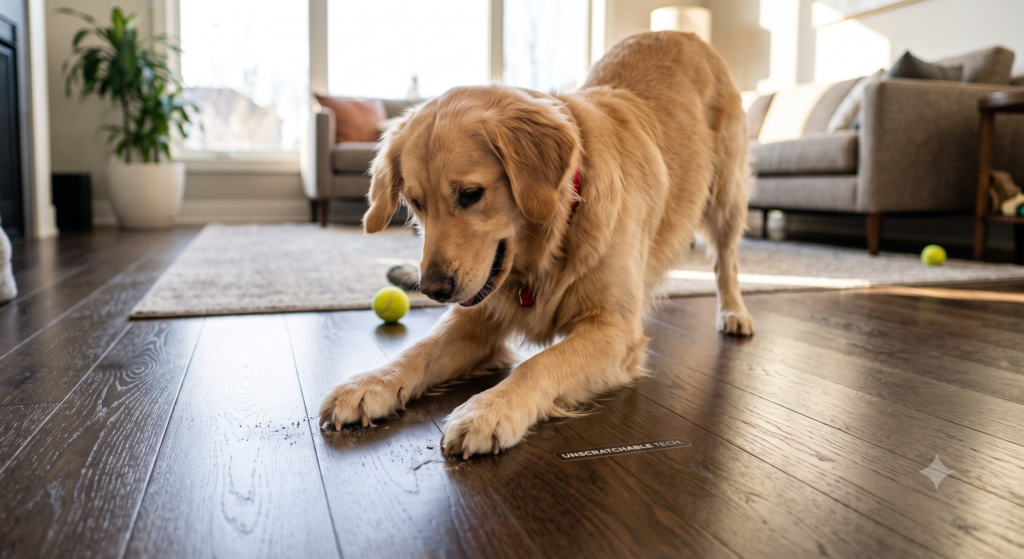
Here is the honest, complete answer that most flooring websites will not give you because they are trying to sell you whatever they have in stock.
The Short Answer
Yes, Golden Retrievers can scratch vinyl floors — but whether they actually will depends almost entirely on one specification that most retail flooring brands deliberately obscure: wear layer thickness.
A Golden Retriever on a 6 mil wear layer vinyl floor will leave visible scratches within one to two years. The same dog on a 20 mil contractor-grade LVP floor will leave almost no marks even after five or six years of daily use.
The dog is not the variable. The floor is.
Understanding Why Large Dogs Scratch Floors
Golden Retrievers typically weigh between 55 and 75 pounds. When a dog that size runs across a hard surface, stops suddenly, or scrambles for traction, the force concentrated through each nail tip onto the floor surface is significant — far more than a human foot in a shoe applies to the same area.
There are three specific scenarios where Golden Retrievers cause the most floor damage:
The running start. Dogs accelerating from a standstill — chasing a ball, greeting someone at the door, reacting to a squirrel outside — drag their rear nails backward across the floor for traction. This motion is particularly harsh on softer wear layers.
The stop and spin. A dog changing direction at speed plants and pivots, concentrating significant force through one or two nail points simultaneously. Over hundreds of repetitions per week, this creates small but cumulative surface abrasions.
The morning scramble. Dogs getting up from lying down on hard floors push off with their back legs in a motion that drags nails across the surface at a sharp angle. On glossy or thin-wear-layer floors, this leaves visible lines over time.
Understanding these specific mechanics matters because different flooring types handle each scenario differently.
How Each Flooring Type Holds Up Against Golden Retrievers
Luxury Vinyl Plank (LVP) — The Best Overall Choice
LVP is our top recommendation for Golden Retriever owners in Ontario, but with one critical qualification: the wear layer must be at least 12 mil, and ideally 20 mil for large dogs.
Here is what that means in practice:
6 mil LVP (most Lifeproof and retail-grade products from Home Depot): A Golden Retriever will leave visible surface scratches within 12 to 24 months of regular use. The scratches are shallow and do not affect the structural integrity of the floor, but they catch light and become increasingly noticeable on darker finishes and glossy surfaces.
12 mil LVP: Holds up well against a single large dog in a normal household. Surface micro-abrasions accumulate slowly and are largely invisible in most lighting conditions. A good choice for families with one dog and moderate daily activity.
20 mil contractor-grade LVP: This is the standard we recommend for Golden Retriever owners. The wear layer is thick enough that normal dog nail traffic — even from a large, active dog over many years — does not produce visible scratching under normal use. This is not a retail product. It is sold through flooring specialists, not big box stores, and the performance difference is immediately apparent when you hold both planks side by side.
Additional LVP advantages for dog owners:
100% waterproof core means accidents, spilled water bowls, and wet paws tracked in from the Ontario snow will never cause warping, swelling, or subfloor damage. The textured surface of quality LVP also provides better traction for dogs than polished hardwood or tile, reducing joint stress over time — a genuine health consideration for a large breed prone to hip dysplasia.
Laminate Flooring — The Scratch Champion
If scratch resistance is your absolute top priority and you are not concerned about waterproofing, high-quality laminate is actually more scratch-resistant than LVP at equivalent price points.
Laminate uses an aluminium oxide coating over a photographic wear layer, which is chemically harder than the PVC wear layer used in vinyl. A high-quality 12mm laminate will resist Golden Retriever scratches better than a comparable 12 mil LVP product.
The trade-off: Laminate is not waterproof. The core is made from wood fibre composites, and if your dog has accidents or your Ontario mudroom regularly sees puddles of melted snow sitting on the seams, laminate will eventually absorb moisture and swell.
Our recommendation: Laminate is an excellent choice for Golden Retriever owners in living rooms, hallways, and bedrooms where moisture is not a regular concern. For kitchens, mudrooms, basements, and any room where wet paws are a daily reality, choose LVP instead.
Engineered Hardwood — Good, With the Right Finish
Many Golden Retriever owners assume they can never have hardwood floors again. That is not accurate, but it requires making two specific choices correctly.
Choose wire-brushed or hand-scraped texture over smooth. A smooth, glossy hardwood finish shows every single scratch, dog hair, and paw print under any light. A wire-brushed or hand-scraped texture has natural variation built into the surface, meaning small scratches from dog nails blend invisibly into the existing texture rather than standing out as bright lines.
Choose light or mid-tone colours over dark. Dark espresso hardwood looks stunning in a showroom and shows every scratch, every piece of dust, and every paw print in a lived-in home. Light oak and mid-tone natural finishes hide imperfections dramatically better.
Choose engineered over solid. Engineered hardwood handles Ontario’s humidity fluctuations better than solid wood, is available in wider planks that are popular with open-concept layouts, and can be refinished once or twice if the surface ever does need attention after years of pet use.
Flooring to Avoid With Golden Retrievers
Solid softwood (pine, fir, poplar): These species are too soft for large dogs. Nail marks appear immediately and the surface dents under normal pet traffic.
Glossy ceramic or porcelain tile: Tile itself is indestructible, but the glossy surface provides no traction for large dogs. Golden Retrievers on polished tile regularly slip and slide, which places chronic stress on their hips and joints. Over a lifetime, this contributes to the hip problems the breed is already genetically predisposed to. If you choose tile, always select a textured or matte finish.
Carpet in main living areas: Carpet traps pet dander, odours, and hair at a level that becomes genuinely unmanageable with a heavy-shedding breed like a Golden Retriever. Reserve carpet for bedrooms and finished basement spaces where the dog spends less time.
The Ontario-Specific Problem Nobody Talks About
Most flooring guides are written for American or British audiences and completely ignore a factor that every Ontario dog owner knows intimately: five months of salt, grit, and ice melt chemicals tracked across every floor in the house.
From November through April, your Golden Retriever comes in from every walk with paws coated in road salt crystals, sand, and chemical ice melt. These particles are abrasive at a microscopic level — essentially fine sandpaper dragged across your floor surface with every step your dog takes from the door to their water bowl.
On a 6 mil retail vinyl floor, this seasonal abrasion compounds the scratch damage from nails and accelerates visible surface wear significantly. On a 20 mil contractor-grade LVP, the wear layer is thick enough to absorb this seasonal abuse without showing meaningful surface degradation even after several Ontario winters.
This is the single most important reason why we recommend a higher wear layer spec for Ontario homes than the general guidance you will find on American flooring websites.
What to Look for When Shopping — The Checklist
When you visit a flooring showroom with a Golden Retriever at home, here is exactly what to ask:
Wear layer thickness: Ask the number in mil. Anything below 12 mil is retail grade. For a large active dog, ask specifically for 20 mil options.
Core type: SPC (Stone Plastic Composite) for any moisture-prone areas. WPC (Wood Plastic Composite) for upper floors and low-moisture spaces.
Total plank thickness: 8mm minimum. Thicker planks feel more substantial underfoot and produce less hollow sound — a consistent complaint about cheaper vinyl that disappears entirely at 10mm and above.
Surface texture: Request a matte or lightly textured finish rather than high gloss. Matte finishes hide micro-scratches dramatically better and do not show paw prints between cleanings.
Attached underlayment: Planks with an attached cork or foam underlayment are warmer underfoot and quieter underfoot — both relevant if your dog has a regular sleeping spot on the floor.
Read other related articles for Best Flooring for Dogs.
See and Scratch-Test in Person Before You Buy
No specification sheet or product photo will tell you as much as holding two planks in your hands and scratching them with your thumbnail.
At the Alliston Flooring showroom, we keep samples of both retail-grade and contractor-grade LVP side by side specifically so dog owners can feel the difference before committing. Bring your dog’s nail clippings if you want — we have had customers do exactly that, and the test results speak for themselves.
We serve Golden Retriever owners and pet households across Alliston, Barrie, Bradford, Newmarket, and Innisfil. Our team will help you match the right product to your specific rooms, your dog’s size and activity level, and your renovation budget — with no pressure and a full written quote at no charge.
Frequently Asked Questions
Do golden retrievers scratch vinyl floors more than other dogs?
Not intentionally. Golden Retrievers are not unusually destructive, but their size and weight mean more force is applied through each nail compared to smaller breeds. A 65-pound Golden running and stopping on vinyl applies significantly more concentrated pressure than a 15-pound terrier doing the exact same thing.
Ultimately, the breed isn’t the problem—the thickness of the flooring’s wear layer is what determines whether your floors will show scratches.
How often should I trim my dog’s nails to protect vinyl floors?
The golden rule from flooring specialists is simple: if you can hear them clicking, they are too long. Nails that click are contacting the floor surface at an angle that increases the risk of scratching.
- For a Golden Retriever: This typically means trimming every 3 to 4 weeks, depending on how much outdoor walking on pavement naturally wears their nails down.
Will pet urine damage LVP flooring?
The LVP planks themselves are 100% waterproof and will not be damaged by pet urine. However, the seams are vulnerable. If urine repeatedly seeps through plank seams to the subfloor below, it can cause subfloor damage and persistent odors over time.
Solutions to prevent subfloor damage:
- Grout-sealing the seams in high-risk areas.
- Choosing a floating installation method, which allows for easy individual plank replacement if an accident does cause damage.
Is heated flooring safe for Golden Retrievers?
Yes. Radiant in-floor heating is completely safe for dogs. In fact, people prefer older or arthritic large breeds who benefit from the gentle warmth on their joints.
- Important Note: If you are installing heated floors, make sure the LVP or engineered hardwood you choose is specifically rated for radiant heat compatibility, as not all products are.
Can I refinish LVP if my dog scratches it badly?
No. Standard LVP cannot be sanded and refinished the way traditional hardwood can.
However, individual planks can be replaced without redoing the entire floor. This is one of the biggest practical advantages of a floating click-lock installation. If your Golden Retriever causes concentrated damage in one specific area—like the spot right by the back door—you can simply swap out those damaged planks without touching the rest of the floor.
About Us Alliston Flooring serves pet owners and dog households in Alliston, Barrie, Bradford, Newmarket, Innisfil, and surrounding Simcoe County, Ontario.